Bucket Trap

The Bucket Trap
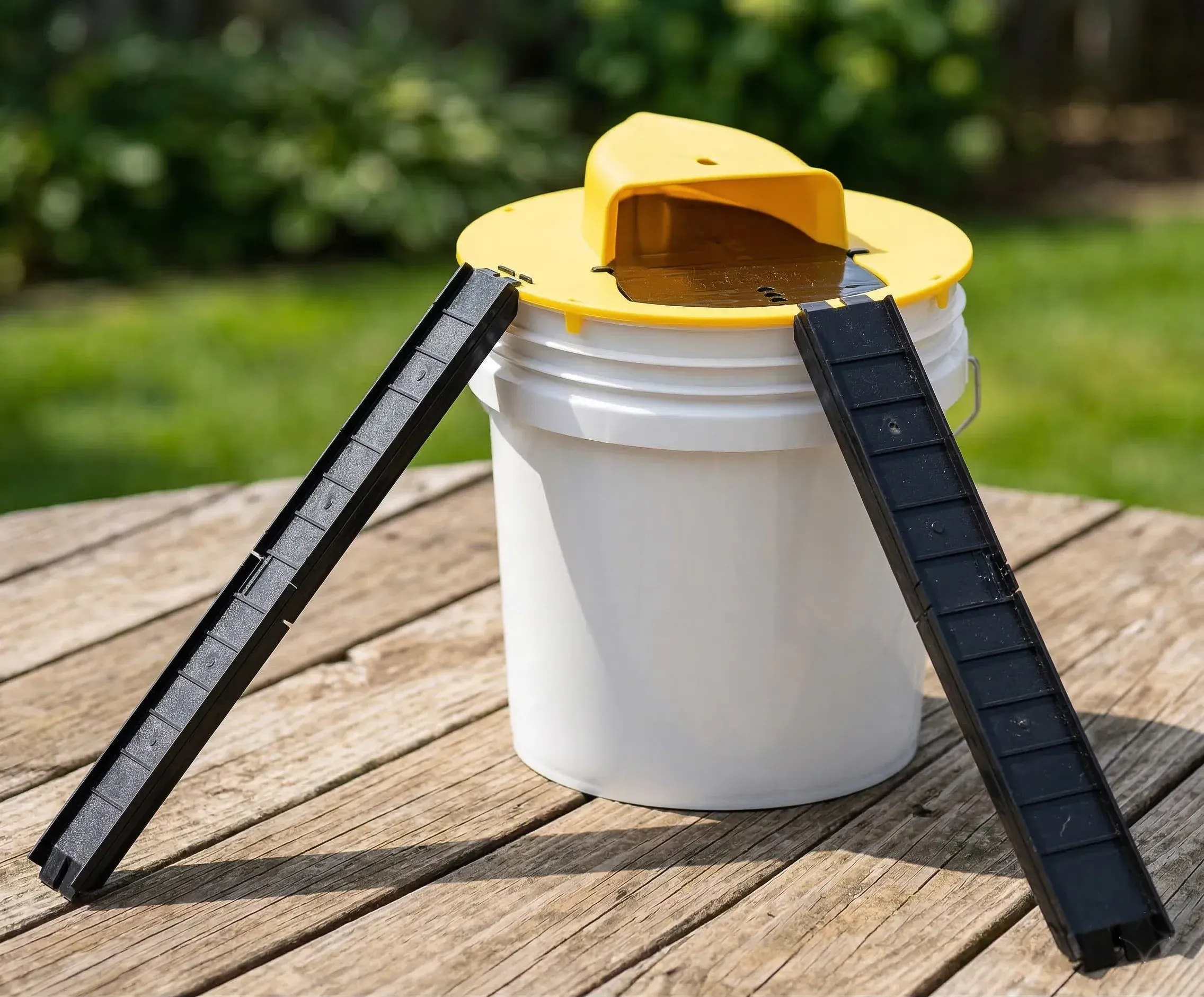
The bucket trap is a mass-capture mechanical system designed for mice and other small rodents. At its best, it combines a ramp, a baited rotating trigger surface, and a kill chamber or containment bucket that can keep working through multiple catches.
Overview
The bucket trap is not a gimmick. It is one of the few systems that can scale from a single intruder to repeated captures without resetting after every trigger. That makes it useful for garages, crawl spaces, sheds, barns, and severe infestations where standard snap traps would require constant re-arming.
Mechanism
At the core of the design is a false floor or rolling can style trigger mounted across the lip of a bucket. The rodent walks up the ramp, commits its body weight to the bait platform, and the platform pivots or rolls under load. Gravity completes the kill or drop.
Trigger Logic
- The bait must pull the rodent onto the unstable centerline.
- The platform must reset after activation for multi-catch performance.
- The bucket depth matters: too shallow and escape becomes likely.
Variants
The bucket trap exists in several common field configurations:
- False Floor Lid: Current best DIY method and most effective design.
- Spinning Roller: An outdated DIY method that fails on smart rodents.
- Water kill bucket: A small amount of liquid prevents recovery after the fall.
- Dry capture bucket: Used for monitoring or live containment, though not recommended for disease-risk species.
Flaws
The bucket trap is not universal. It has very specific failure points:
- It is bulky compared with snap traps.
- Poor ramp angle causes hesitation and refusal.
- Cheap lids often fail to reset cleanly.
- In living spaces it can be visually intrusive and harder to position discreetly.
Synergies
The bucket trap performs best when paired with the rest of the protocol:
- Pre-baiting builds confidence before activation.
- Wall-guided access improves approach behavior.
- Exclusion work reduces reinfestation after the catch cycle.
- Cleanup discipline prevents scent contamination and secondary attraction.
Deployment
Deploy the bucket trap where volume matters more than aesthetics:
- Place it along established runways, not in open random floor space.
- Use a stable ramp and make sure the platform pivots freely.
- Bait lightly. Too much bait reduces commitment and can change the balance point.
- Check daily and reset sanitation around the bucket after catches.
Best Use Cases
- Detached garages
- Basements
- Barns and storage buildings
- Heavy recurring mouse pressure
When To Choose Something Else
Use a snap trap instead if you are dealing with one or two cautious mice in a finished interior room. Use exclusion materials instead if the core problem is active re-entry through structural gaps.
Conclusion
The bucket trap is an S-tier volume tool when deployed in the right environment. It is not the prettiest solution, but for repeated capture efficiency it remains one of the most effective pieces of hardware in the rodent-control toolkit.
Responses (0)
Loading comments...